
Reclaiming the In-Between: Rethinking Space Beneath Elevated Infrastructure

Jiayao Tang, ASLA
Junior Associate
Cities are full of spaces that exist not by intention, but by consequence. Among the most overlooked are the areas beneath elevated highways and bridges — zones often treated as residual land created by transportation infrastructure. These environments are typically fragmented, poorly programmed, or abandoned altogether. Instead of contributing to the public realm, they become visual voids and physical barriers within the urban fabric.
This condition is not accidental. Under-bridge spaces were rarely designed as destinations. They are the byproducts of engineering priorities, safety setbacks, and regulatory constraints. As a result, they are frequently excluded from planning conversations, despite occupying some of the most central and connective locations in cities.
Yet these spaces represent a significant untapped resource. When left unmanaged, they tend to amplify urban challenges such as poor lighting, noise, perceived safety risks, and social isolation. But when intentionally activated, they can support public gathering, recreation, ecological performance, and cultural expression. Consistent human presence, lighting, and programmed activity can also deter nefarious behavior and improve the perception of safety, transforming formerly avoided areas into trusted civic spaces. At a time when cities face land scarcity and growing demand for inclusive public space, ignoring these areas perpetuates spatial and social inequities.
Why Are Under-Bridge Spaces So Often Abandoned?
Several structural factors contribute to their neglect:
They are planned as byproducts, not destinations. Infrastructure is designed first; leftover land is addressed last, if at all.
They fall into regulatory gray zones. Ownership and maintenance responsibilities are often unclear, discouraging investment.
They are associated with risk rather than opportunity. Noise, shade, and safety perceptions overshadow their spatial potential.
These challenges are not only physical; they reflect broader assumptions about what cities consider usable or valuable space.
Case Studies: Activating the Space Beneath Infrastructure
Grassroots Activation — Washington Street Skate Park
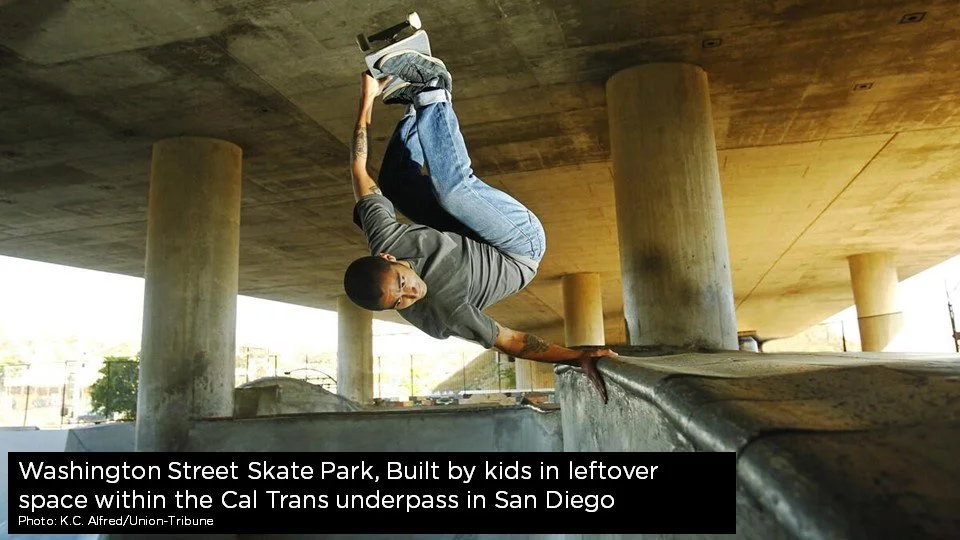
A compelling example of grassroots activation can be found at Washington Street Skate Park in San Diego. Beneath a freeway overpass, local skateboarders transformed an unused underpass into a self-built skate environment. Working with the structural rhythm of concrete columns and the shelter provided by the bridge above, the community created a space uniquely adapted to its surroundings.
What began as informal occupation evolved into a recognized urban destination. The park demonstrates how community-led initiatives can reveal the latent social and recreational potential of infrastructural voids. Rather than treating informal use as a nuisance, this case suggests that spontaneous activity can function as an early design prototype, showing how people naturally adapt to leftover space.
This project represents grassroots activation — where informal community occupation precedes and inspires formal recognition of space.
Local Precedent: Community Activation at Chicano Park
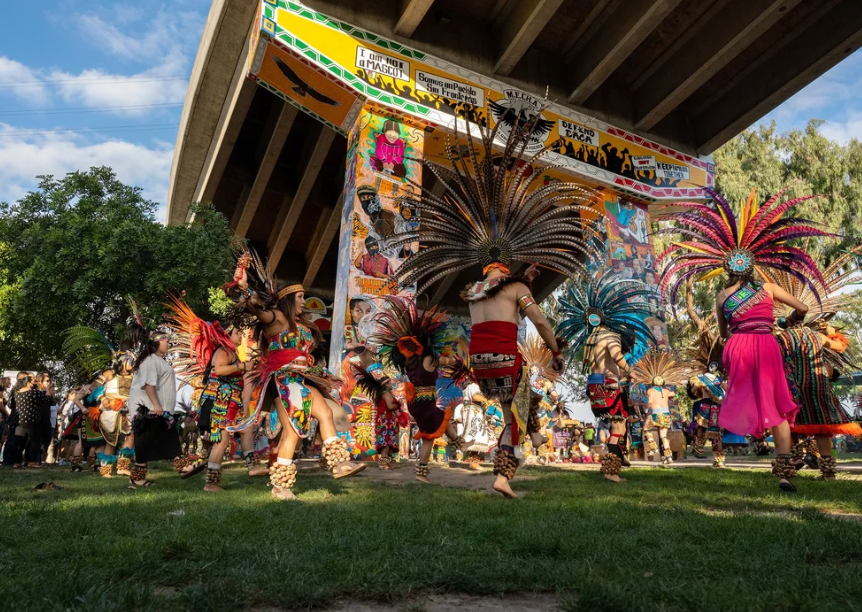
1. Members of Danza Mexicayotl perform under the arches of the MEChA mural at Chicano Park. Photo by Joe Orellana*
A powerful local precedent can be found at Chicano Park in San Diego’s Barrio Logan neighborhood. Located beneath the San Diego–Coronado Bridge, the park emerged through community activism in the 1970s when residents reclaimed the under-bridge space and transformed it into a cultural and civic landmark. Today, the site contains one of the largest collections of outdoor murals in the United States and functions as an active public gathering space.
Rather than erasing the presence of infrastructure, Chicano Park integrates it into its identity. Bridge columns serve as canvases for large-scale murals, while the shaded environment supports community events, informal recreation, and daily social activity. The project demonstrates how under-bridge environments can evolve into meaningful public places when communities assert ownership and cultural expression.
As a long-standing example of locally driven activation, Chicano Park illustrates that infrastructure spaces can sustain vibrant civic life over decades, reinforcing the idea that these environments are not residual voids but potential anchors of neighborhood identity.
Transportation Corridor Reimagined — Atlanta BeltLine
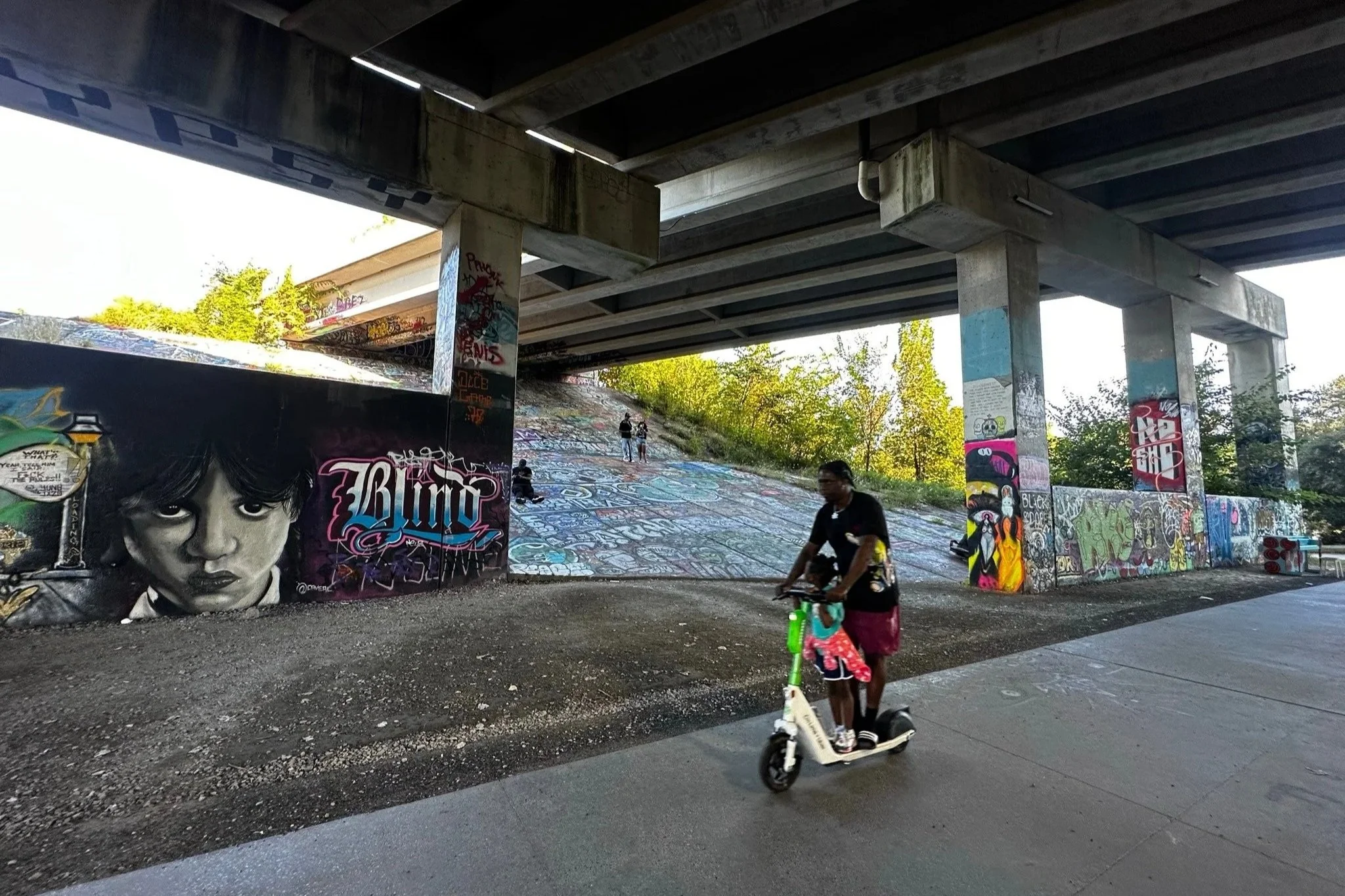
Image by David McCullough during travels to Atlanta
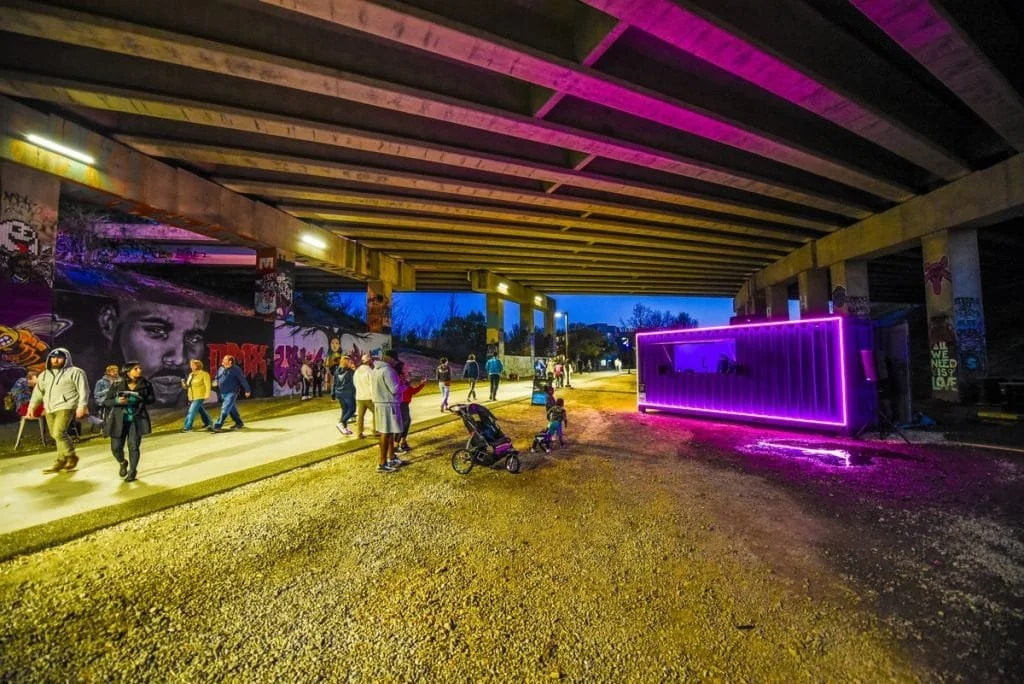
2. A/V Radio on the BeltLine by Dylan York, originally published on Secret Atlanta
While many under-bridge projects focus on localized activation, the Atlanta BeltLine demonstrates how underutilized infrastructure corridors can be reimagined at a metropolitan scale. Built along former rail lines and passing beneath roadways and bridges, the BeltLine transforms previously neglected right-of-way spaces into a continuous multi-use trail network that supports walking, cycling, transit integration, and adjacent development.
Importantly, the BeltLine reframes leftover and infrastructural edge conditions as connective tissue — linking neighborhoods, parks, and cultural districts. Underpasses are not treated as gaps in the experience but as opportunities for lighting installations, murals, wayfinding, and safe crossings. The project illustrates how transportation infrastructure and public realm investment can operate simultaneously, reinforcing mobility, equity, and civic life.
Designed Civic Infrastructure — The Bentway & Underpass Park
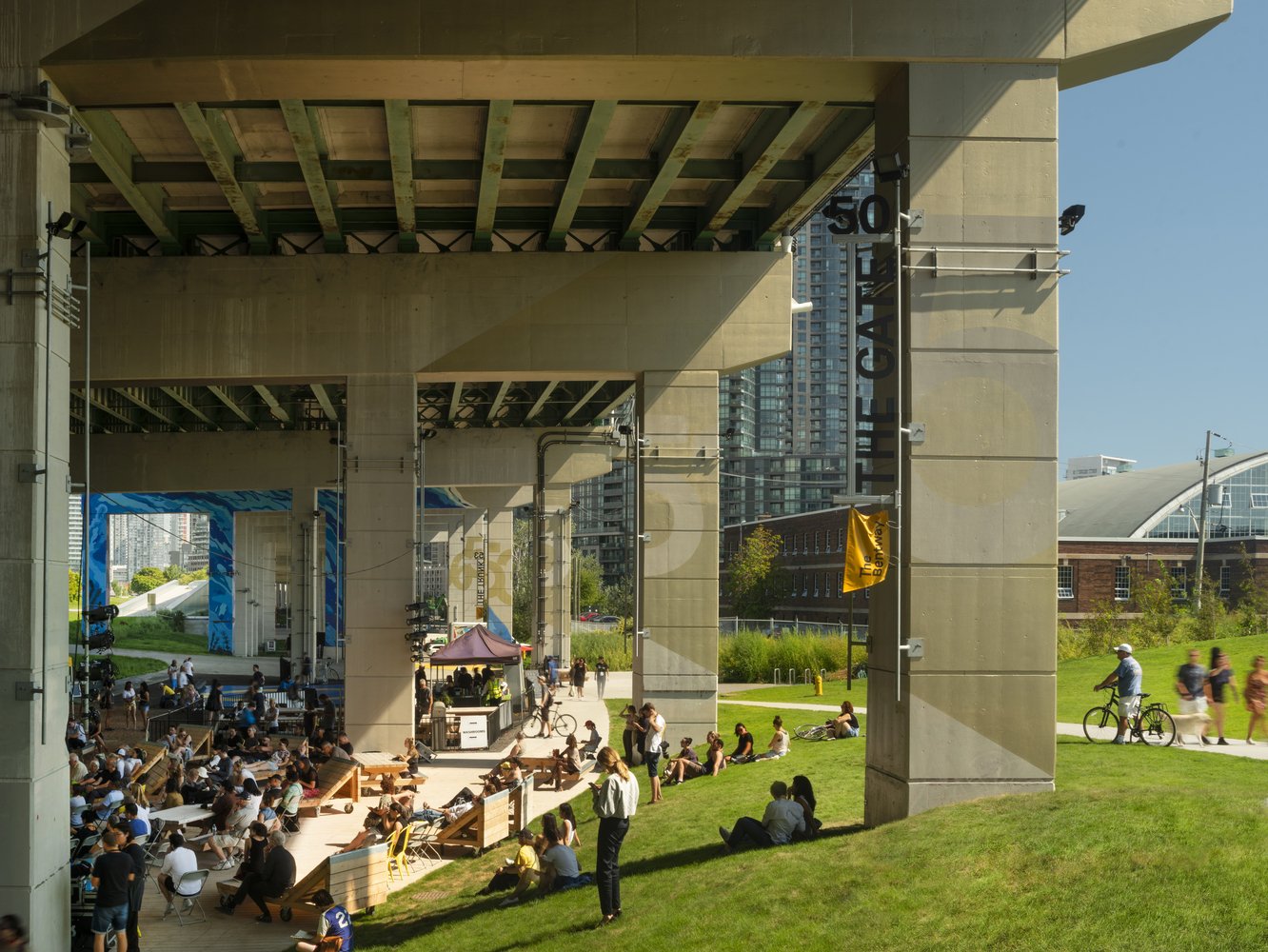
3. The Bentway / Public Work . Image © Nic Lehoux / Arch Daily*
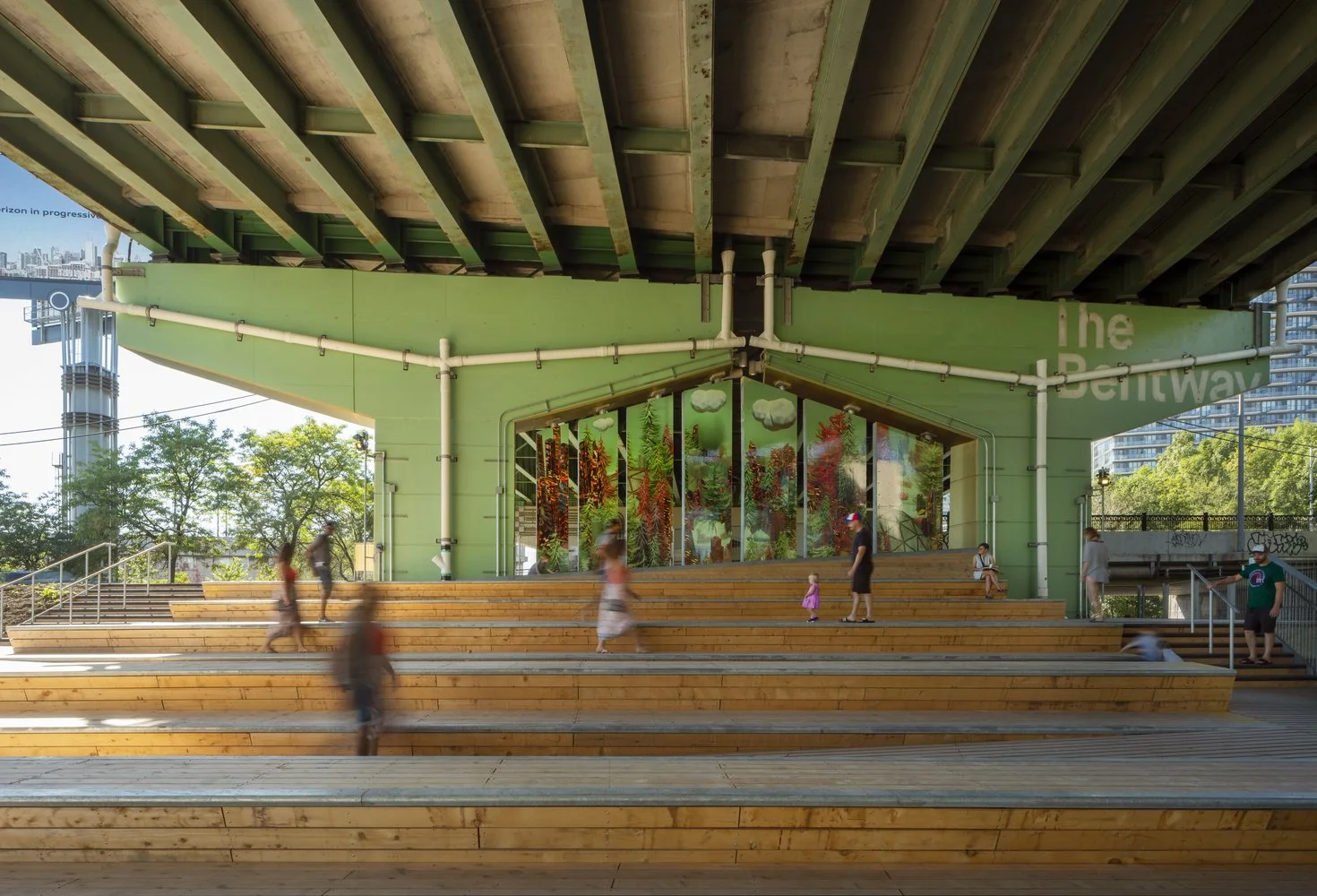
The Bentway / Public Work, Courtesy of Arch Daily.*
At a civic scale, projects such as The Bentway and Underpass Park in Toronto illustrate how intentional design can expand upon principles first revealed by informal community use. Through lighting strategies, recreation zones, art installations, and flexible programming, these projects transform under-bridge environments into active public corridors.
By addressing visibility, safety, and environmental comfort, they redefine formerly neglected infrastructure spaces as destinations capable of supporting year-round use. These projects demonstrate how formal design frameworks can institutionalize activation strategies and integrate them into broader urban systems.
Local Exploration: Transformative Climate Communities (TCC) Urban Greening Plan — San Diego
California Climate Investments
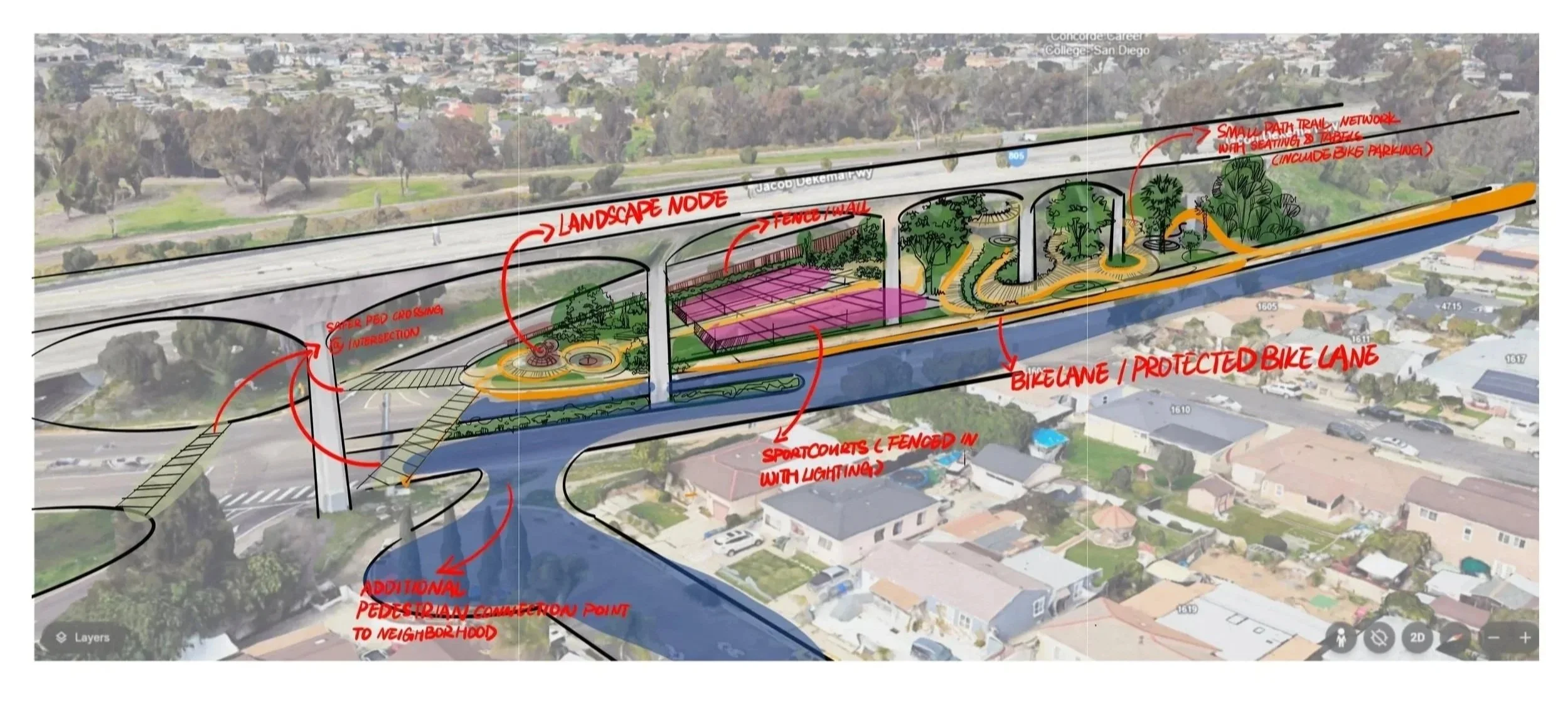
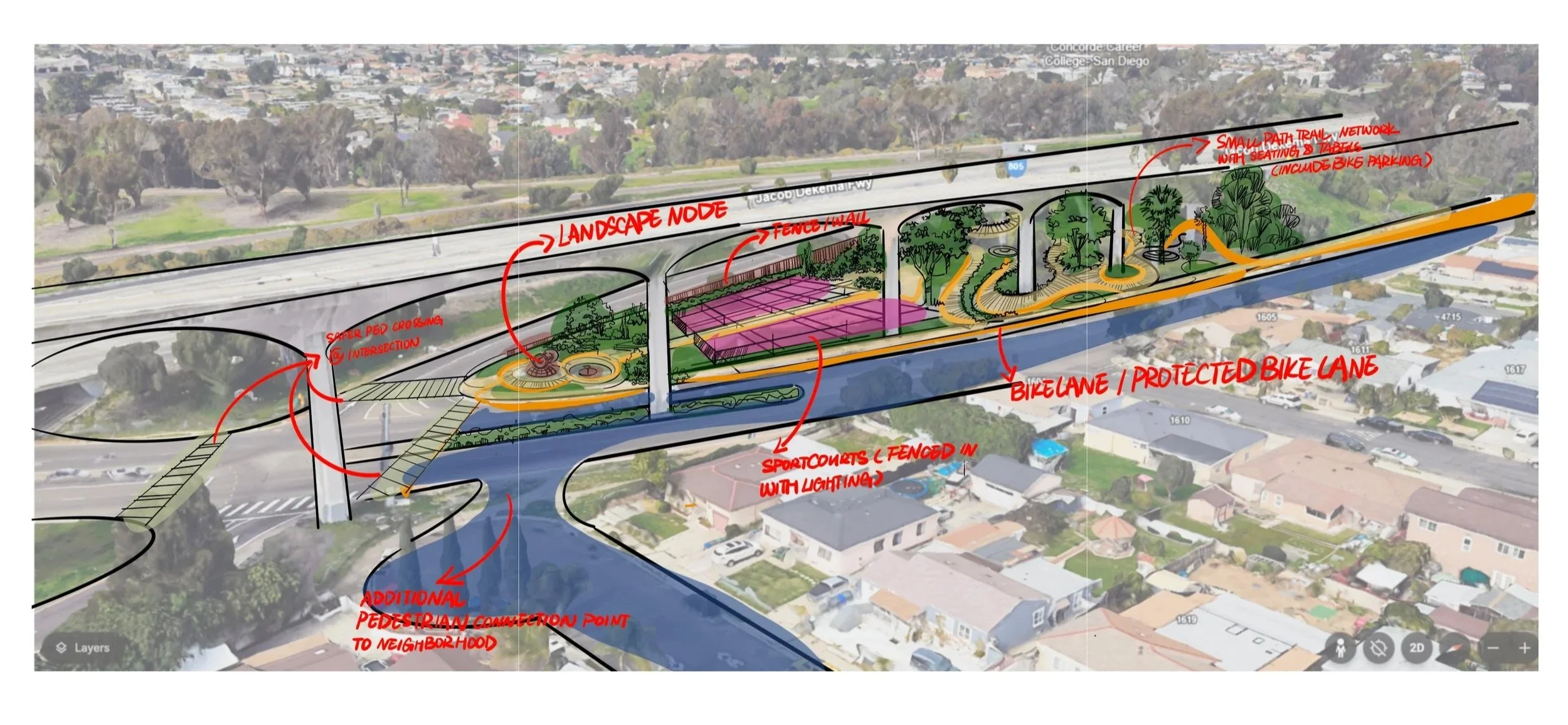
During the development of the Transformative Climate Communities (TCC) Urban Greening Plan — part of California’s Climate Investments program — our team identified an overlooked opportunity beneath an elevated freeway corridor. Rather than treating the under-bridge area as residual infrastructure, the project team began exploring how it might function as a connector between neighborhoods, mobility networks, and public space.
Through early site observations and conceptual sketching, we tested a series of spatial ideas that respond directly to the site’s existing conditions. Initial sketches explored protected bike lanes extending through the underpass, improved pedestrian connections to adjacent neighborhoods, and shaded landscape nodes that could support informal gathering and recreation. The structural rhythm of the bridge columns was used as an organizing framework, creating a sequence of spatial zones within the corridor.
This phase of work focused on exploration rather than final design. By documenting site conditions and translating them into preliminary sketches, we began reframing the under-bridge environment as a potential civic asset rather than leftover space. These early studies establish a foundation for future planning discussions and demonstrate how local projects can reinterpret infrastructure as part of an evolving public realm network.
Shared Strategies Across Successful Projects
Across these examples, several common principles emerge:
Redefine the role of the space — Treat underpasses as corridors of activity, not gaps to be filled.
Design for use before form — Prioritize human occupation and programming.
Address safety through presence — Continuous activity fosters security more effectively than exclusion.
Integrate social and environmental value — Combine recreation with ecological performance.
Work with infrastructure constraints — Use noise, structure, and shade as design parameters.
A Call to Action
Unlocking the potential of under-bridge spaces requires a shift from avoidance to intentionality. Cities and design teams can begin by:
Identifying underutilized infrastructure zones within public space planning
Testing temporary pilot programs
Integrating these areas into mobility and resilience strategies
Engaging communities to define meaningful uses
These spaces were never meant to be destinations. But with thoughtful planning, they can become some of the most adaptable and inclusive environments in the city. The question is not whether they can work — but whether cities are ready to see them differently.
*Image Credits
1. Joe Orellana. Members of Danza Mexicayotl perform under the arches of the MEChA mural at Chicano Park. Originally published found on Chicano (Park) Power — palabra.
2. Dylan York. A/V Radio on the BeltLine in Atlanta. Originally published on Secret Atlanta
3.. The Bentway / Public Work, Toronto. Originally published on Arch Daily.